


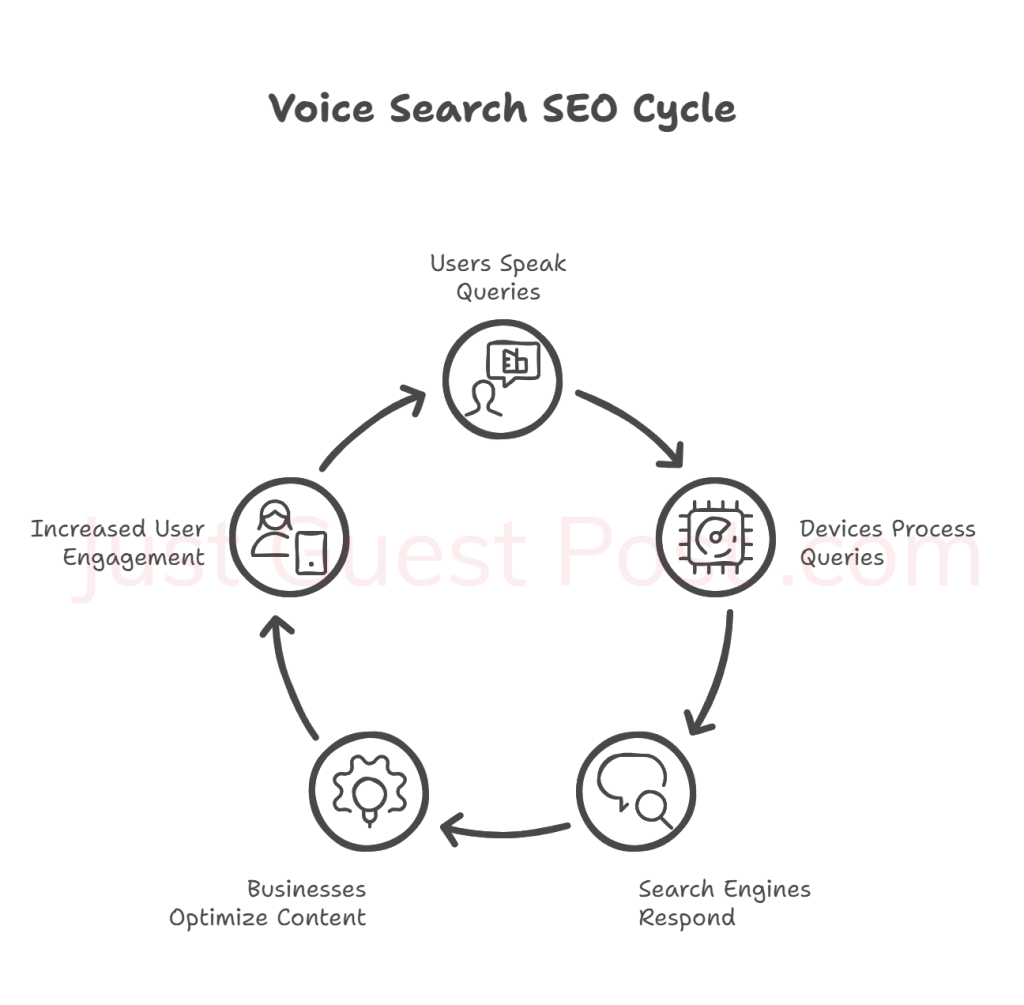
Hey there! Picture this: you’re rushing to meet a friend for dinner, and you ask your phone, “What’s the best Italian restaurant near me?” Siri or Google Assistant promptly provides you with an accurate recommendation. That’s the magic of voice search, and in 2025, it’s changing the SEO game like never before.
With over 31.5% of Americans using voice search daily and more than 157 million voice assistant users expected by 2026, optimizing your website for voice search isn’t just a nice-to-have—it’s a must. Whether you’re a small business owner dipping your toes into SEO or a seasoned marketer looking to sharpen your edge, this guide has you covered.
Let’s dive into how you can make your site the go-to answer for voice queries, with tips for beginners, advanced strategies for experts, and some extra nuggets for the pros.
What Is Voice Search and Why Should You Care?
Voice search lets people use spoken commands to find information through devices like smartphones, smart speakers, or even TVs. Unlike typing “coffee shop” into Google, users might say, “Where’s the nearest coffee shop open now?” This shift to conversational, question-based queries is reshaping SEO.
According to Neil Patel, 31.5% of Americans aged 18–65 use voice search daily, and the number of voice assistant users is skyrocketing. For businesses, this means more opportunities to connect with customers, especially for local searches like “near me” queries, which dominate voice search.
Why does this matter?
Voice search results often come from Google’s featured snippets—those concise answers at the top of search results. If your content isn’t optimized, you’re missing out on traffic and visibility.
Plus, voice search boosts your overall SEO by improving mobile-friendliness and user experience. Let’s break it down step by step, starting with the basics for beginners and moving to advanced tactics for experts.
Understanding Voice Search: The Basics
Voice search relies on virtual assistants like Siri, Alexa, and Google Assistant, which use speech recognition to process spoken queries. Unlike text searches, which are short and keyword-heavy, voice searches are longer and more natural.
For example, someone might type “best pizza” but say, “What’s the best pizza place in Chicago?” This conversational style means your SEO strategy needs to adapt.
Voice searches fall into three main types:
- Informational: “How do I make a latte at home?”
- Navigational: “Find directions to the nearest gym.”
- Transactional: “Order flowers online near me.”
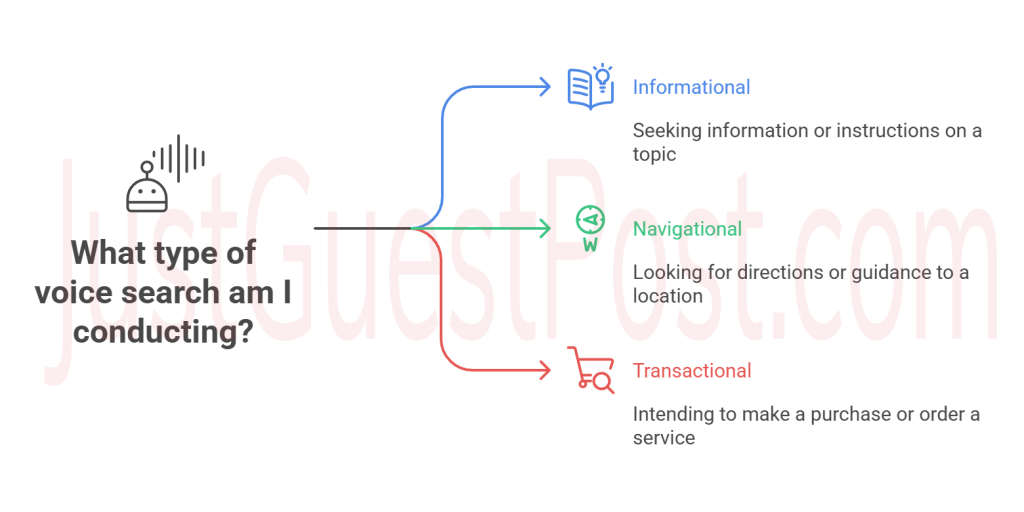
Most voice search results are pulled from featured snippets, which Google selects as the most direct, relevant answer. To rank here, your content needs to be clear, concise, and structured to answer questions directly.
Let’s explore how beginners can start optimizing for voice search.
Voice Search SEO for Beginners: Simple Steps to Get Started
If you’re new to SEO, don’t worry—voice search optimization is approachable with a few key steps. Here’s how to get your website ready for voice queries.
Find Conversational Keywords
Voice search thrives on long-tail, question-based keywords that mimic how people talk. Instead of targeting broad terms like “bakery,” aim for phrases like “What’s the best bakery near me?” or “Where can I find gluten-free cupcakes in Seattle?” Tools like Ubersuggest and AnswerThePublic are your best friends here. Ubersuggest’s “Questions” feature shows common queries related to your topic, while AnswerThePublic visualizes how people ask about it, like “How to…” or “Where is…”
For example, if you own a pet store, you might target “What are the best dog toys for puppies?” Include these phrases in your content, headings, and meta descriptions to match user intent. Spend an hour exploring these tools to build a list of 10–20 keywords to start with.
Write Like You Talk
Your content should sound natural, like a conversation with a friend. Use pronouns like “you” and “we” to connect with readers, and avoid jargon that might confuse voice assistants. Aim for a 9th-grade reading level or lower—tools like Hemingway can check this for you. For instance, instead of writing, “Optimal canine nutrition requires balanced macronutrients,” say, “Here’s how to feed your dog a healthy diet.”
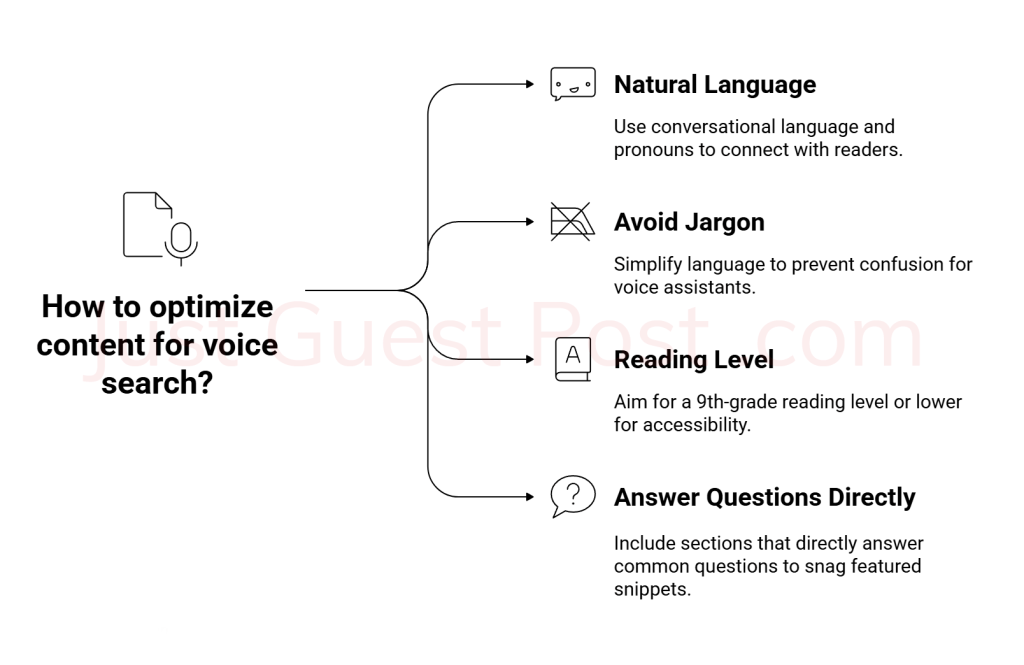
To snag featured snippets, answer questions directly in your content. If someone asks, “How do I groom my cat at home?” include a section like:
How to Groom Your Cat at Home
Grooming your cat is easy with these steps: brush their fur daily, trim nails monthly, and clean their ears with a vet-approved solution. Use a soft brush to avoid skin irritation.
Keep answers concise (around 30 words, per The Hoth) to fit voice search responses.
Boost Local SEO
Many voice searches are location-based, like “Find a coffee shop near me.” Optimize your Google Business Profile with accurate details: name, address, phone number (NAP), hours, and categories. Encourage customer reviews, as they influence rankings. Also, add local keywords to your site, like “coffee shop in Denver,” to capture these queries.
Make Your Site Mobile-Friendly and Fast
Since 90.4% of voice searches happen on smartphones, per Neil Patel, your site must be mobile-friendly. Test it with Google’s Mobile-Friendly Test. Speed is also critical—voice search results average a 4.6-second load time. Use PageSpeed Insights to aim for a Speed Index below 2 seconds. Simple fixes like compressing images or using a content delivery network (CDN) can help.
Add Basic Schema Markup
Schema markup is like a label that tells search engines what your content is about. For beginners, start with simple schemas like Article or LocalBusiness using plugins like Yoast SEO. For example, a LocalBusiness schema for a bakery might include your address and hours, making it easier for Google to pull your info for voice queries.
Advanced Techniques for SEO Experts
If you’re already comfortable with SEO, these advanced strategies will help you take voice search optimization to the next level.
Advanced Schema Markup
Beyond basic schemas, use specific types like HowTo, FAQPage, or Recipe to boost your chances of appearing in voice results. For instance, a HowTo schema for “How to bake sourdough bread” can structure steps clearly for Google.
Here’s an example of FAQ schema:
<div itemscope itemtype="https://schema.org/FAQPage">
<div itemscope itemprop="mainEntity" itemtype="https://schema.org/Question">
<h2 itemprop="name">What is voice search SEO?</h2>
<div itemscope itemprop="acceptedAnswer" itemtype="https://schema.org/Answer">
<div itemprop="text">Voice search SEO optimizes content for spoken queries on virtual assistants like Siri or Alexa.</div>
</div>
</div>
</div>
Semantic SEO
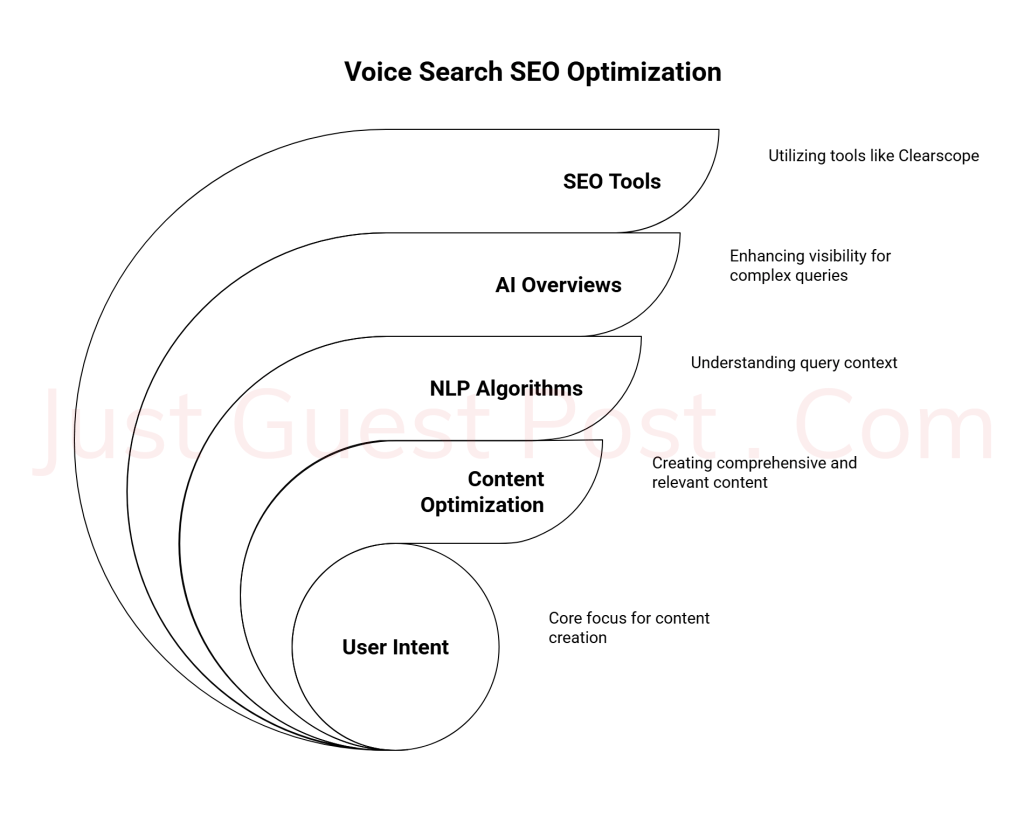
Voice search relies on semantic understanding, thanks to Google’s algorithms like RankBrain and BERT. Use tools like Clearscope or Frase to identify related topics and entities. For example, if you’re optimizing for “voice search SEO,” include terms like “natural language processing,” “featured snippets,” and “local SEO” to create a comprehensive page. This signals to Google that your content is authoritative and relevant.
Track and Analyze Performance
Monitor your voice search performance with tools like Ubersuggest or Semrush. Track rankings for your long-tail keywords and check if your pages appear in featured snippets or “People Also Ask” sections. Since Google Analytics doesn’t directly track voice search, look at mobile traffic and question-based keyword performance as proxies. Update your content regularly based on these insights to stay competitive.
Special Tips for SEO Experts
For those who live and breathe SEO, here are some cutting-edge tips to stay ahead in voice search.
Leverage AI and NLP
Google’s natural language processing (NLP) algorithms, like BERT, analyze the context of queries. To optimize, create content that deeply matches user intent. For example, if targeting “How to start a blog,” cover related questions like “What’s the best blogging platform?” or “How much does it cost to start a blog?” Use Clearscope to ensure your content addresses all angles. This also helps with AI Overviews, Google’s comprehensive answers for complex queries, which are becoming more common in 2025.
Anticipate Future Trends
Voice search is evolving fast. With over 8 billion voice assistants in use globally, per AIOS, smart home devices are a growing frontier. Optimize for commands like “Turn on the lights” by integrating with platforms like Alexa Skills. Also, visual search (e.g., Google Lens) is merging with voice—include descriptive alt text for images to capture these queries.
Optimize Video Content
Videos are increasingly featured in voice search results. Optimize titles and descriptions with long-tail keywords, like “How to make a perfect latte at home.” Add closed captions for accessibility and SEO, and use YouTube’s keyword tools to find voice-friendly phrases. For example, a video titled “Best Yoga Poses for Beginners” could rank for “What are easy yoga poses to do at home?”
Conclusion: Get Ready for the Voice Search Revolution
Voice search is no longer a futuristic concept—it’s here, and it’s reshaping SEO in 2025. By targeting conversational keywords, structuring content for snippets, and optimizing for mobile and local searches, you can make your site a go-to for voice queries. Beginners can start with simple steps like updating their Google Business Profile, while experts can dive into schema markup and semantic SEO to stay ahead. The key is to keep experimenting and stay updated, as voice search evolves rapidly.
Ready to make your site voice-search-ready? Start small—pick one page, add a FAQ section, or optimize for a local keyword. If you want to scale your efforts, JustGuestPost can help with SEO-optimized content and link-building strategies to boost your rankings. Let’s make your website the one Siri picks first!
Citations:
The Hoth: Voice Search SEO Optimization
Neil Patel: Mastering Voice Search
Forbes: Voice Search SEO Practices
Digital Marketing Institute: A Guide to Voice Search Optimization
Boston Institute of Analytics: 15 Voice Search SEO Strategies For 2025
AIOS: Voice Search is Becoming More Popular
FAQs: Your Voice Search Questions Answered
These FAQs are optimized for voice and AI search, using conversational, question-based phrasing to match how users speak to virtual assistants.
Voice search SEO optimizes your website to appear in results from spoken queries on devices like Siri, Alexa, or Google Assistant, focusing on conversational keywords and snippets.
Voice searches are longer, conversational, and often question-based (e.g., “What’s the best pizza near me?”), while text searches are shorter and keyword-focused (e.g., “pizza restaurant”).
Focus on long-tail, question-based keywords like “How do I…” or “Where can I find…” Use tools like Ubersuggest to find these phrases.
Answer questions directly in your content, use clear H2/H3 headings, and add schema markup like FAQPage to increase your chances of being selected for snippets.
Yes, many voice searches are location-based, like “near me.” Optimize your Google Business Profile and use local keywords to capture these queries.
Schema markup helps search engines understand your content, boosting your chances of appearing in voice results and featured snippets, per The Hoth.
Write conversationally, use simple language (9th-grade level or below), and check readability with Hemingway.
Ubersuggest, AnswerThePublic, and Clearscope are great for finding conversational, voice-search-friendly keywords.
Track long-tail keyword rankings with Ubersuggest or Semrush. Check for featured snippet appearances and mobile traffic in Google Analytics.
Expect more smart home device integration, advanced NLP like BERT, and visual search growth. Optimize for these with schema and video content.